The changing face of children’s literature in Nepal
From Panchayat-era moralism to donor-driven publishing, and today a rising crop of local initiatives, the shifts in Nepal’s children’s literature reflect the difficult history of the country itself
AT THE 31ST Congress of the International Board on Books for Young People (IBBY), held in Copenhagen in 2008, the scholar Biswambhar Ghimire presented a paper outlining the history of children’s literature in Nepal. His research is dotted with important dates and details reminding us that the Nepali general public was largely prohibited from attaining even basic literacy until the fall of the autocratic Rana regime and Nepal’s first, abortive experiment with democratic rule in the 1950s. This historical constraint is worth keeping in mind as we turn to the current state of children’s literature in Nepal, which can be understood as part of the broader landscape of elementary education in the country.
The first book written in the Nepali language exclusively for children was Gorkha Paila by Gangadhar Shastri, published in 1892. Until then, Sanskrit was the primary language that formally appeared in print. Gradually, a handful of generous elite intellectuals and reform-minded rulers wrote books for children; among them was Jaya Prithvi Bahadur Singh, who published a few in 1901.
While much of the population might have been illiterate, childhood in Nepal – as elsewhere in Southasia and beyond – was in good part shaped by oral traditions of improvised lullabies, folktales and stories. Nepali folk writers, school teachers and even nationally renowned intellectuals – like Laxmi Prasad Devkota and Lekhnath Paudyal – wrote stories for children. Some of these stories, along with translated excerpts from Aesop’s Fables and the ancient Indian fable Panchatantra, were included in school textbooks and taught to successive generations.
Yet, rather than reflecting Nepal’s linguistic and ethnic diversity in print and visual culture, much of this work reinforced the hegemony of a single tongue and ethnic group: respectively, the Nepali language, and the Khas-Arya people of Nepal’s middle hills. The Panchayat period from 1961 to 1990, which followed the curtailment of democracy in the 1950s and put power in the hands of the Shah monarchy, enforced the primacy of the Nepali language and the Hindu religion. This ideological narrowing fostered a climate of censorship where language activists from marginalised communities were jailed and dissenting voices were systematically discouraged.
December 2025. At the Patan Museum, Safu, the publishing imprint of Quixote’s Cove – an organisation dedicated to the creation of art and literature – launched a picture book titled Sangye Wants a Shyoldo. The story is set in Gatlang, a village of the Tamang community in northern Rasuwa district, bordering Tibet. Young Sangye wants his own shyoldo, a traditional long coat made of fine sheep wool woven on a backstrap loom. Gatlang residents were invited to the launch event, which included a Tamang dance performance and a shyoldo-making activity.
At the Nepal Academy, FinePrint, a major publishing house, launched Yelp! Yeti! Chaos in Kathmandu – a graphic novel for children by Sneha Pradhan, illustrated by Promina Shrestha – which was first published in the United Kingdom and distributed in the United States by Penguin Random House. Featuring rich illustrations, its blend of comics and storytelling is itself novel in Nepal’s publishing scene.
Since the promulgation of Nepal’s 2015 constitution, which established a federal democratic republic after the end of the monarchy and a long civil war, there have been growing efforts in the country’s arts and literature to represent diverse identities and voices. By inviting community members to the event and highlighting aspects of their culture, Safu signalled that its goals extend beyond the mercantile aspects of selling books. This approach acknowledges Nepal’s multilingual, multi-ethnic reality and seeks to nurture socially aware young readers. That’s why Sangye Wants a Shyoldo, originally written in English, was translated into the Nepali and Tamang languages as well, with all three versions now available in the market.
Yet the journey from what was to what is today has been long and complicated, mired in negligence and misunderstandings. It was only after the 20th IBBY Congress in 1986, in Tokyo, that the folk writer Chudamani Bhusal – supported by what was then the Royal Nepal Academy – conducted a writers’ workshop on children’s literature in Kathmandu in August 1987, with Manorama Jafa, a prolific children’s author from Delhi’s Association of Writers and Illustrators for Children. That same month, a national seminar titled “Children’s books and reading in Nepal” was held.
I can only speculate, but this cluster of activity may have marked a moment when public intellectuals were beginning to wake up to a broader crisis in the country’s children’s literature. Less than a month later, in September, the Nepalese Society for Children’s Literature (NESCHIL) – described as “an independent academic and nonprofit organization” – was formed.
NEPAL’S CHILDREN’S LITERATURE sector cannot be understood without reference to the country’s unique political history: starting from 1846, a cruel 104-year-long Rana autocracy, followed by three decades of exclusionary Panchayat policies and, since the 1990s, an unstable and corrupt democratic order, punctuated by absolute royal rule for periods of the civil war. In this context, leadership in shaping children’s literature has frequently come not from the state but from literary civil society leaders, alongside foreign donors and development agencies. These actors have played a central role in educating stakeholders, providing support and logistical funds to refine quality, and encouraging greater care in selecting the content of literature made available to Nepali children.
Given the two key terms that anchor the field – “children” and “literature” – it is perhaps unsurprising that educators and writers remain deeply involved in the sector. Rato Bangala School, founded in 1992 with progressive educational ideals, has been particularly influential in shaping both Nepali children’s worldview as well as their literary sensibilities. (Disclosure: Kanak Mani Dixit, Himal Southasian’s editor from 1987 to 2016, is from the same family that founded and runs the school.) The school has long collaborated with Bank Street College of Education in New York City, known for developing innovative curricula that encourage children to create art and write stories from an early age.
Through its philanthropic wing, Rato Bangala has also trained government schoolteachers in Nepal’s marginalised far-western districts such as Dailekh, introducing contemporary pedagogical ideas like the importance of matching children with books at their appropriate reading level. In 1995, the school established its own publishing arm, Rato Bangala Kitab, which produces Big Books and models what it means for children’s literature to be genuinely child-friendly – attentive to word count per page, visual density and font size.
Nepal's public-school wars
Two decades later, in 2015, the school launched Bal Sahitya Mahotsav, a literature festival for children. The 2024 edition featured a special guest – the American author Linda Sue Park, a recipient of the John Newbery Medal for excellence in children’s literature for her novel A Single Shard, set in 12th-century Korea. The book features an orphan and a person with disability, and takes readers back in history. Its layered themes tell us that literature for children can and ought to be complex, challenging and immersive, particularly in today’s digital age dominated by short-form videos.
The book is usually assigned to students in grades 5 through 8, though many adults may also enjoy it and find the content meaningful. To that end, some experts argue that strict distinctions between children’s and adult literature are unnecessary: we all mature at different rates, and everyone encounters challenges at different points in their lives, regardless of age.
EVEN TODAY, experts use the terms “children’s books” and “children’s literature” interchangeably, and there is some confusion regarding the role and value of books specifically written for children. Are they exclusively educational materials? Or should they be viewed more as artistic products? Bhusal, who attended the IBBY conference in 1986, addressed this ambiguity in a 2004 introduction to the second edition of Pramod Pradhan’s Nepali Balsahityako Itihaas, a history of children’s literature in Nepal originally published in 2000. He explains that the primary purpose of Pradhan’s thesis in the book is to establish children’s literature as a distinct discipline with its own considerations, separate from textbooks and other school-related educational materials.
Pradhan was inspired to undertake this project after attending the Nepal Academy workshop in 1987. His research includes chapters elaborating related concepts and clarifying ideas associated with children’s literature, with sections on Muna – a monthly Nepali magazine for children – and even popular children’s songs.
We're on a mission to give Southasian literature the spotlight it deserves. Become a Himal Patron to support our work!
IBBY uses the broader term “books for young people” instead of “children’s book”, and its website notes that it offers a separate award for Reading Promotion. In the United States, the John Newbery Medal is awarded to “an author of the most distinguished contributions to American literature for children”, while the Caldecott Medal focuses specifically on picture books.
I learnt more about NESCHIL from Bhanu Bhattarai, who joined its executive committee in 2024 and currently serves as its secretary. Reviewing meeting notes since 1987, Bhattarai noted that there had been proposals every year to organise an international children’s book festival in Nepal – an ambition that, for decades, remained unrealised.
That long-deferred dream was finally achieved in September 2024, albeit with an adapted name and focus, when the International Children’s Literature Conference was held at the Nepal Academy. In recent years, NESCHIL has also convened national meetings on children’s literature in numerous districts across both the southern plains and the middle hill region of Nepal. The organisation’s 30th national meeting, with guests from all over Asia, took place in Liwang, in the southwestern Rolpa district, in December 2025.
Bhattarai currently runs Kopila Kitab, a private children’s literature publishing company, which he founded alongside two colleagues in 2021. He left his earlier venture, Sachitra Kitab, after its team chose to pursue a business strategy commonly used by booksellers in Nepal – striking deals with international and local NGOs that purchase books in bulk for free distribution as part of their development programmes.
“Because regular Nepali parents don’t really buy books for children,” Bhattarai explained, pointing to the country’s generally feeble reading culture. At Kopila’s office in Kathmandu, he elaborated on why it was important to develop alternative economic models, particularly ones rooted in long-term local partnerships that could gradually boost the industry. “Since our primary goal at Kopila is to target children who live outside the Kathmandu Valley, we began partnering with local governments.”
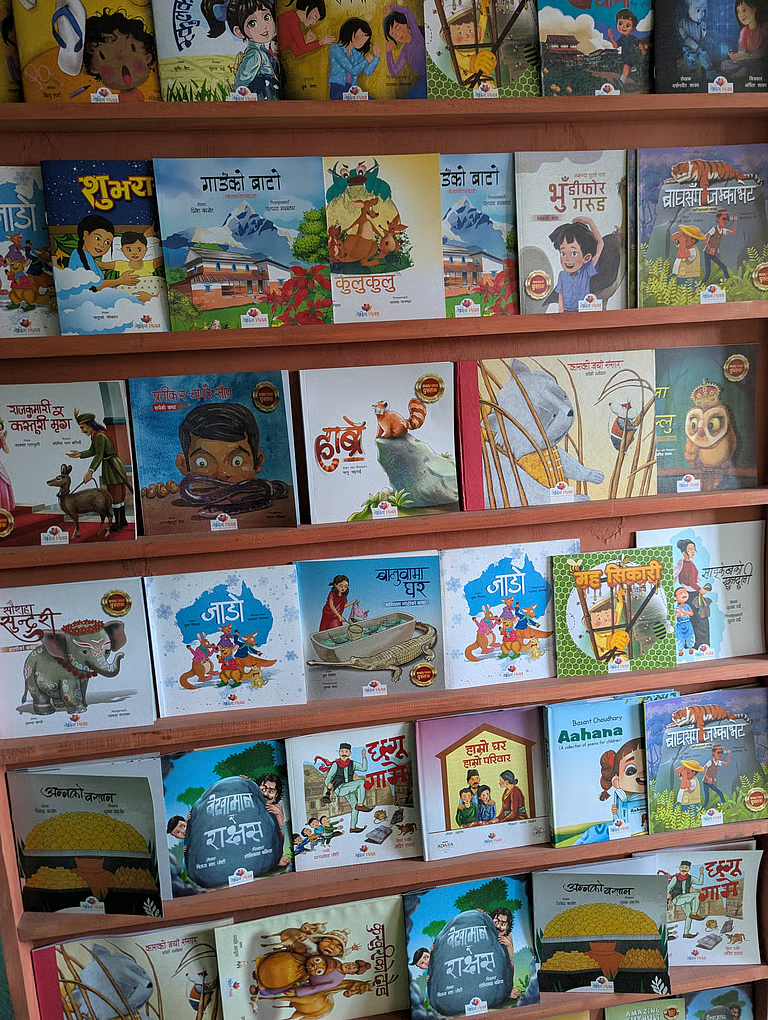
A display at Kopila Kitab, private children’s literature publishing company in Nepal. A new wave of children’s literature is pushing past didactic traditions, prioritising inclusive representation, child-centred pedagogy, and stories grounded in the country’s diverse linguistic and ethnic contexts. Photo courtesy: Niranjan Kunwar
Over the past four years, Kopila has collaborated with village development committees across Baglung, a hilly district in central Nepal, as well as in Rupandehi, in the southern plains, introducing swathes of children to its catalogue of more than sixty titles.
What are some factors preventing children’s books published in Nepal from meeting international standards? This question has long guided Bhattarai’s work. Perhaps because he studied graphic design in college, his initial focus was on the books’ physical qualities: size, layout and paper quality. It was only after participating in a long-term project jointly organised in the late 2000s by the Danish embassy, NESCHIL and Room to Read – another organisation influencing the sector in Nepal – that he began to reflect more critically on form and content. “We were unaware of the basic format of children’s literature,” he recalled.
Over the project’s four-year run, numerous writers and illustrators received training and institutional support, resulting in almost six thousand new titles entering the market. Bhattarai remains in touch with Sally Altschuler, the Danish children’s book author and lecturer who participated in the initiative and who now conducts free workshops twice a year for Kopila’s network of writers and illustrators. Altschuler’s books have also been translated into Nepali and published by Kopila Kitab, as well as other publishing houses such as Kathalaya, which focuses on translated foreign children’s literature as part of its publishing strategy.
WHILE INTERNATIONAL EXPERTISE offers much to learn from, Nepal’s over-reliance on development aid – and its over-eagerness to defer to foreign interventions – has often produced unintended negative consequences. Room to Read, globally hailed as one of the fastest-growing NGOs in history, provides a revealing example. It was founded in 2000 by an American who, while travelling through Nepal in the 1990s, encountered a school headmaster struggling to access quality books for his students – he was then inspired by a mission “to bring access to quality education to every child regardless of where they were born.”
Room to Read distributes boxes of free books to underprivileged communities. While undeniably generous, this model directly affects private publishing houses, which must compete not only with one another in a fragile local market but also with high-quality books produced in the West as well as lower-cost editions printed in India and China.
Queer literature for children is changing minds in India
Anuradha, a prolific author of children’s literature, worked in Room to Read’s Quality Reading Material (QRM) department from 2016 to 2018. During her tenure, she coordinated workshops with writers and illustrators aimed at producing original Nepali-language stories. Selected manuscripts were summarised in English and reviewed by the organisation’s global team, which then approved funding for publication. Anuradha eventually left Room to Read because its policies didn’t allow staff to publish their own creative work while employed there. This reflects both the creative potential nurtured within institutional frameworks and the limits they often impose.
Anuradha’s chapter book Alien, written in Nepali, is now assigned by several schools to young students across the country. Earlier this year, she published Sarbatiya ko Gada, a story featuring a young Madhesi girl and set in Nepal’s historically poor and neglected southern Tarai region – bringing marginalised geographies and identities into a children’s literary landscape that has long overlooked them.
In Anuradha’s book, the protagonist, Sarbatiya, is an important, intersectional character – one capable of nurturing the sociopolitical consciousness of contemporary Nepali students growing up in a federal, democratic country. The character stands in sharp contrast to those from Panchatantra stories, which can be patriarchal and didactic, often reinforcing traditional family values over critical engagement with social difference.
While initiatives by NESCHIL – such as producing content on menstruation and adapting materials for blind students – are certainly commendable, it is also important to acknowledge the organisation’s institutional legacy. It was founded during the Panchayat era, and NESCHIL’s current executive committee members are primarily dominant-caste men from Nepal’s hill region – the country’s most powerful social and political group both historically and in the present day. This composition is in sharp contrast with that of Srijanalaya, an NGO led largely by women of the Newar community and focused on delivering arts education to students from groups marginalised during the Panchayat era, like the Newars themselves. To further its core mission, Srijanalaya collaborated with the Asia Foundation’s Let’s Read programme in 2017 to produce children’s literature in Nepal Bhasa, the language of the Newar people.
Much like in Room to Read’s QRM workshops, here writers and illustrators received mentorship and explored ways to translate old Newar children’s songs into English and Nepali, reimagining them as picture books. The resulting titles – like The Great Hairy Khya – were published by Safu in November 2018. It’s worth noting, as an example of productive collaboration, that Sangye Wants a Shyoldo was the result of an art residency organised by Srijanalaya. The book’s writer and artist spent a few weeks in Gatlang, immersing themselves in the daily lives and rituals of the villagers.
In keeping with the Let’s Read programme’s emphasis on accessibility, digital versions of the Newar children’s books are freely available online on their website, along with audio recordings that allow children and parents to listen to the stories. Building on this work, and with support from Let’s Read Asia, in 2020 Srijanalaya went on to produce 20 more picture books in the language of the Tharu people – a marginalised community indigenous to the Tarai. Online conversations anchored around these books – coordinated by Katha Satha, a Kathmandu-based literary organisation – are also publicly available on YouTube.
As noted earlier, however, donor-funded projects come with constraints, and additional private investment is often required to push the publications they foster into the mainstream market. While the Nepali translations of the Tharu titles were published by Kathmandu Publication, a third set of children’s books produced by Srijanalaya in the Tamang language is still awaiting funding to bring it to the wider world.
Anuradha also pointed to a range of other issues plaguing Nepal’s children’s literature sector. For example, government policies regarding fees and royalty frameworks for writers and illustrators remain unclear, leaving many practitioners without consistent protections. While interest in locally published picture books – dominated by visuals and aimed at children below the age of six – has certainly grown over the past few decades, significant gaps remain in the availability of chapter books for older students and fluent readers. The same is true of literature for young adults.
Kanak Mani Dixit’s Adventures of a Nepali Frog, originally published 30 years ago and translated into almost ten different languages, is often cited as a rare success story: a chapter book rooted in Nepal that has travelled well beyond its original context. More recently, Sangrila Books has begun focusing more on the older children who typically read chapter books, commissioning the popular Nepali novelist Buddhisagar to write his first one, Mero Pattu, Mero Biralo.
TO UNDERSTAND the shifts in children’s books and their production, I spoke to the executive director of Sangrila, Anbika Giri. A writer known as an outspoken critic of patriarchy and feudalism, Giri has a personal history shaped by growing up in Nepal’s southern plains and an early political awareness of caste and gender inequalities. In 2019, she published Saniko Gyani Kura, a book dedicated to her daughter and aimed at teaching young girls about “good touch and bad touch”. The book, later translated into English as Sani’s Wise World, is assigned reading in some primary schools, and was reprinted last year. In 2025, Sangrila published the English translations of three of Giri’s books, all featuring young girls as protagonists: Payal Goes to School, Superhero Sister and Lakshu’s Silence. While Safu and Srijanalaya are taking Nepal’s many ethnicities and languages into account in their output, Sangrila’s focus on gender is still important in order to empower young readers and counter stereotypes.
Reflecting on her own school days and early encounters with children’s stories, Anbika lamented that much of Nepal’s children’s literature of the past sidestepped critical social questions. She agreed that most of the stories available, whether drawn from Panchatantra tales or Panchayat-era textbooks, were preachy and moralistic, offering children a narrow, simplistic and uncomplicated worldview. That legacy, she argued, continues to cast a long shadow over Nepal’s mainstream children’s literature. The series Anbika has authored is intended as a corrective – one that resists the tendency to shelter young readers from sociopolitical realities.
Environmentalism is no longer just a fable in Southasian children’s literature
With female protagonists still relatively rare in Nepali children’s books and with representation of the country’s many ethnic communities still limited, Anbika remains committed to expanding the scope of who is seen and heard, and enthusiastic about continuing her efforts. But qualitative interventions such as hers often collide with the hard realities of business. Producing children’s literature is typically more complex and more expensive than publishing adult fiction, largely due to the inclusion of illustrations. Even when local publishers invest considerable time, effort and resources, Anbika noted, elite consumers often prefer Western titles.
As an example of both ambition and constraint, she pointed to Poshan Varnamala, a brightly illustrated “big book” on nutrition that is priced at NPR 500 – roughly USD 3.5. Bhattarai had observed how even a median price of NPR 250 per book can place locally produced children’s literature beyond the reach of many middle-income Nepali families.
WHEN I BECAME connected to van Doesburg Creative Works, a Zurich-based publishing company founded by Sandra van Doesburg, who was born in Kathmandu to a Nepali woman, I pitched an idea for a chapter book. We agreed that in our increasingly globalised world, where children and adults cross borders more frequently, it was crucial to feature young characters navigating diverse familial and geographic boundaries.
My book Mijok’s Trip – set in Nepal’s eastern region and centred on a young Limbu girl who loves soccer – was launched last year, and is aimed at a demographic similar to that of A Single Shard. Beyond exploring the intersection of gender and ethnicity, the book employs the liberating backdrop of travel. I also included Phalgunanda, a spiritual leader of the Limbu community, who appears in Mijok’s dream as an androgynous persona.
Producing impactful children’s literature requires an understanding of children’s developmental trajectories, and of how young readers from specific socioeconomic and cultural backgrounds are influenced by local and global forces. In 2015, Srijanalaya’s first residency programme gave two art-school graduates the chance to spend nearly a month in two communities on the outskirts of Pokhara, in central Nepal. Their task was to engage deeply with locals and capture the landscape, local stories and emerging ideas in their notebooks, which would then serve as the basis for original narratives and visuals for picture books.
The Journey, a picture book about migration by the writer and illustrator Ubahang Nembang, and Sanu and the Big Storm, the artist Bandana Tulachan’s book about a fishing community living by Pokhara’s Phewa Lake, were also translated into Nepali and published by FinePrint. The entire process was comprehensive and time-consuming, including numerous feedback sessions for the two writer-illustrators as well as editorial guidance. This was repeated for Sangye Wants a Shyoldo.
If we truly want Nepal’s children to grow up as engaged, socially conscious citizens connected to their local communities and ecology, we need to invest similar time and effort in mentoring young professionals, while keeping Nepal’s diversity in mind. Thankfully, there are encouraging signs. Over the past two decades, graduates from newly established art schools, having refined both their aesthetic and business skills, have been setting higher standards for qualitative design. The government as well as private schools are increasingly open to innovative ideas, having recognised the value of investing in childhood education. Even in today’s world of foreign-aid cuts and anti-diversity measures, I hope the children’s books publishing scene in Nepal will continue to expand and flourish. △
Share: